

Grisly Triple Murder in Uttar Pradesh’s Shamli: Man Kills Wife and Two Daughters Over Burqa Dispute, Buries Bodies in Home Pit
Shamli, Uttar Pradesh | December 17, 2025 I Grisly Triple Murder in Uttar Pradesh’s Shamli: Man Kills Wife and Two Daughters
In a horrifying incident that has shocked the rural community of Garhi Daulat village in Uttar Pradesh’s Shamli district, a man allegedly murdered his wife and two young daughters following a domestic dispute triggered by his wife leaving the house without wearing a burqa. The accused, identified as Mohd Farooq (also spelled Farukh in some reports), confessed to the crime after police interrogation, revealing that he shot his wife and elder daughter, strangled the younger one, and concealed their bodies in a seven-foot-deep pit dug in the courtyard for a toilet, which he later covered with concrete.The victims have been named as Tahira (Farooq’s wife, age approximately in her 30s), Afreen (elder daughter, around 14 years old), and Sahreen (younger daughter, about 6 years old). The murders are believed to have occurred around December 10, 2025, but remained undiscovered for nearly a week as Farooq continued to live normally in the village, even misleading family members about their whereabouts.
The Discovery and Police Investigation
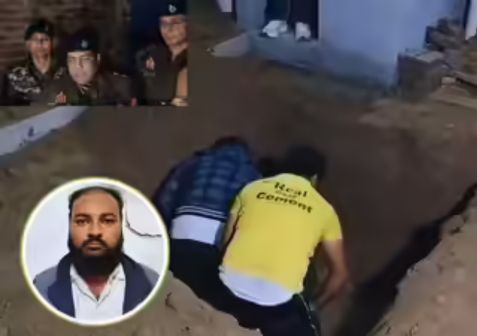
The case came to light when Farooq’s father, Dawood, grew suspicious after his daughter-in-law and granddaughters went missing for several days. Dawood, who lives separately from Farooq due to ongoing family tensions, inquired about their location. Farooq initially claimed he had shifted them to a rented house in nearby Shamli town for safety. Unsatisfied with the explanation, Dawood approached the Kandhla Police Station and filed a missing persons report.Shamli Superintendent of Police (SP) N.P. Singh told reporters that a police team immediately began investigating. “As soon as we received information about the missing woman and her two daughters, our team swung into action. During questioning, inconsistencies emerged in Farooq’s statements, prompting stricter interrogation,” SP Singh said.Under sustained questioning, Farooq broke down and confessed to the triple murder. He led police to the spot in the courtyard where he had buried the bodies. Forensic teams and excavators were called in to recover the remains from the pit, which had been intended for a septic tank or toilet construction. The recovery process, conducted in the presence of magistrates and villagers, drew large crowds and sent waves of grief and anger through the community.Post-mortem examinations are underway to confirm the cause of death, though police sources indicate gunshot wounds on Tahira and Afreen, and strangulation marks on Sahreen.
The Trigger: A Dispute Over Burqa and Ongoing Tensions
According to police statements, the immediate trigger for the violence was a heated argument over Tahira leaving the in-laws’ house to visit her parental home without wearing a burqa (or hijab, as mentioned in some accounts). Farooq reportedly became enraged by this, viewing it as a breach of cultural and religious norms he expected his wife to follow.However, investigators have revealed deeper underlying issues. Farooq and Tahira had been experiencing marital discord for several months, marked by frequent quarrels. Farooq was reportedly facing financial difficulties, and a recent fight escalated when Tahira demanded money. “He confessed that he was struggling financially. His wife asked for money, leading to an argument. She then went to her parents’ home without a burqa, which infuriated him further,” SP Singh elaborated.Farooq lived separately from his parents, Dawood and Asgari, with whom he had strained relations. This separation meant that the murders went unnoticed initially, as the family was not in daily contact.
The Accused: A Portrait of Farooq
Little is known publicly about Farooq’s background beyond his residence in Garhi Daulat village under Kandhla Police Station limits. Villagers described him as a quiet man who kept to himself, though whispers of domestic troubles had circulated for some time. Farooq has no prior criminal record mentioned in initial reports, making the brutality of the crime even more startling to locals.After his confession, Farooq was placed under formal arrest and charged with murder under relevant sections of the Bharatiya Nyaya Sanhita (BNS). He remains in police custody as investigations continue. Police are also probing whether anyone else was aware of or aided in concealing the crime.
Community Reaction and Broader Concerns
The revelation of the murders has left the village in a state of profound shock and mourning. Neighbors expressed disbelief, with many recalling Tahira as a devoted mother and the daughters as playful children. “They were a normal family. We never imagined something like this could happen here,” said one villager, speaking on condition of anonymity.Women’s rights activists and local leaders have condemned the incident, highlighting it as an extreme manifestation of patriarchal control and domestic violence. “This case underscores the dangers of rigid interpretations of cultural norms that restrict women’s autonomy,” said a representative from a local NGO focused on gender issues. “Arguments over clothing should never escalate to violence, let alone murder.”The incident has also sparked discussions on rising domestic violence in rural Uttar Pradesh, where financial stress, marital discord, and conservative social pressures often intersect tragically. According to national crime data, Uttar Pradesh consistently reports high numbers of crimes against women, including dowry-related harassment and honor killings, though this case appears rooted more in personal rage than organized honor crime.
Similar Cases and Societal Reflection
This tragedy echoes several recent cases in Uttar Pradesh involving familial murders hidden within homes. In past years, bodies concealed in pits, wells, or under floors have surfaced in districts like Farrukhabad and Faridabad (nearby in Haryana), often tied to disputes over money, infidelity suspicions, or family honor.Experts point to socioeconomic factors: unemployment, poverty, and lack of mental health support in rural areas as contributing elements. “Financial strain can exacerbate existing tensions, leading to impulsive acts of violence,” noted a psychologist familiar with rural UP cases.The burqa dispute adds a layer of cultural sensitivity. While the burqa or hijab is a personal choice for many Muslim women, enforced veiling has been a point of contention in some conservative households. Women’s groups argue that such control reflects broader gender inequalities.
Ongoing Probe and Justice Ahead
Police have assured a thorough investigation, including ballistic analysis of the weapon used (reportedly a country-made pistol) and psychological evaluation of the accused. The bodies have been handed over to relatives for last rites after autopsy.As Garhi Daulat village grapples with grief, demands for swift justice grow louder. “The accused must face the full force of the law. No one should escape punishment for such a heinous act,” SP Singh affirmed.This case serves as a grim reminder of the hidden horrors within families and the urgent need for societal interventions to prevent domestic violence. Counseling helplines, community awareness programs, and stronger enforcement of laws protecting women could help avert future tragedies.The Shamli triple murder not only claimed three innocent lives but also exposed fractures in family bonds that, left unaddressed, can turn deadly.
Sources: Reports from IANS, Free Press Journal, Amar Ujala, Aaj Tak, and police statements as of December 17, 2025.
.

Rakesh Pandey is a seasoned media professional and editor with over 20 years of rich experience spanning print, digital, and electronic (television) media in India and abroad.